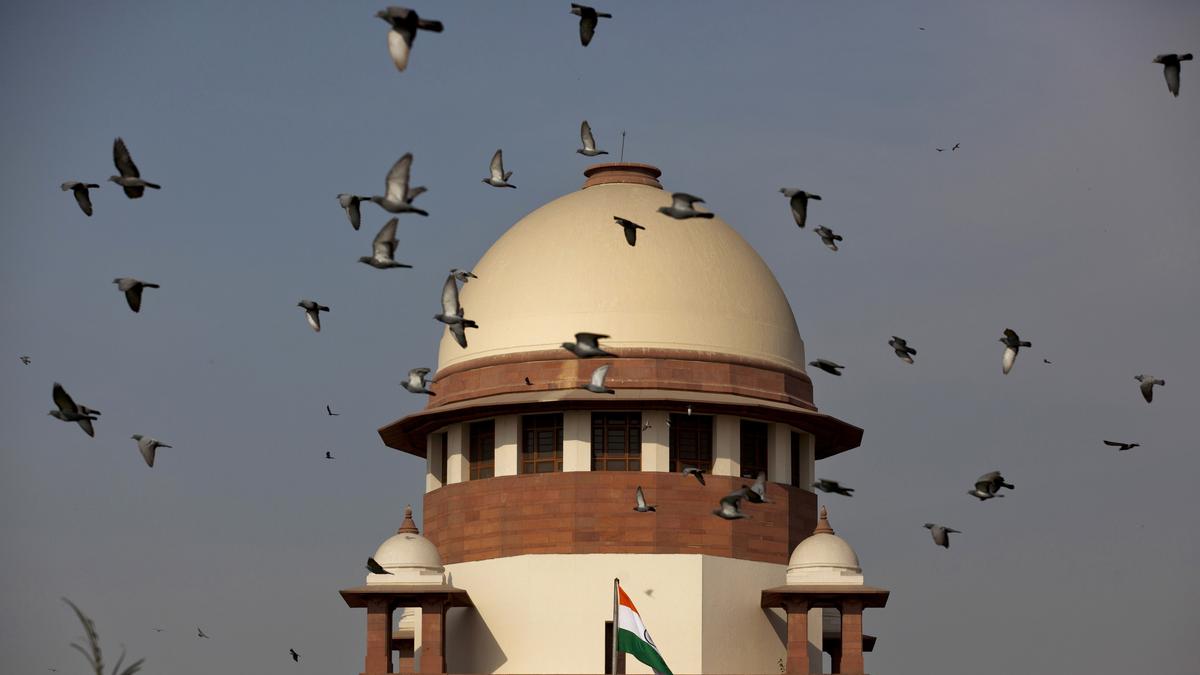
The Supreme Court of India has heard arguments on the Presidential Reference in respect of the Governor’s powers under Article 200 pertaining to the assent to Bills passed by the State legislature. Earlier, a two-judge Bench, headed by Justice J.B. Pardiwala, had fixed a timeline of three months for the Governor to take a final decision on a Bill submitted to him for assent. The same timeline was made applicable to the President of India also.
The time limit fixed by the Court has raised eyebrows in the government as well in the media. The general refrain from a section of the media was that the Court cannot direct the Governor or the President, who are high constitutional authorities, to act within a specified time when the Constitution does not have any such time frame. The government had also taken this line of argument in the Court.
Reiteration of a recognised principle
Article 200 of the Constitution has four options for the Governor when a Bill is presented to him after being passed by the State legislature. These options are to assent to the Bill; to withhold assent; return the Bill to the Assembly with a request to reconsider the Bill as a whole or certain clauses, or reserve it for the consideration of the President.
A very important question which arose in the context of the Governor’s role in dealing with a Bill after it is passed by the legislature is whether the Governor has any discretion in the exercise of any of the options mentioned above. Under Article 163, the Governor is required to exercise his functions only on the aid and advice of the Council of Ministers except in matters specified by or under the Constitution. The Court has, in cases from Shamsher Singh vs State of Punjab (1974), to Nabam Rebia (2016), made it clear that the Governor cannot perform any of his executive functions except on the advice of the Council of Ministers headed by the Chief Minister. The Sarkaria Commission and Punchhi Commission too reiterated this well-recognised constitutional principle.
The point that has been emphasised in all the judgments of the Court and the judicial commissions is that the Governor is just a constitutional head and that the real executive power of the state is vested in the elected government. Therefore, the Governor cannot act independently.
So, the question of crucial importance in this context is whether the Governor, while exercising any of the options under Article 200, can act in his discretion. The answer to this question will become clear when we take a close look at the Government of India Act, 1935. Section 75 of this Act is substantially the same as Article 200. Section 75 uses the words “the governor in his discretion” which means that giving assent or withholding it or sending the Bill back to the legislature or reserving it for the consideration of the Governor General is done by the Governor in his discretion.
This Section has been virtually reproduced in Article 200 but omits the words “in his discretion”. This would show that the Constitution-makers wanted the Governor to exercise the power under Article 200 only on the advice of the Council of Ministers.
The issue of ‘discretion’
The question of discretion of the Governor under Article 200 is one that has been dealt with by the Court in a number of cases. Surprisingly, the Court, in Shamsher Singh, discovered a discretionary power in the Governor under Article 200. It held that he must exercise it to the best of his judgement and should pursue a course which is not detrimental to the state.
But the Court, in The State of Tamil Nadu vs The Governor Of Tamilnadu and Anr. (2025), did not accept the idea of a Governor exercising his discretion in withholding assent or reserving the Bill for the consideration of the President. It says, “if the power to withhold assent to Bills or to reserve them for the consideration of the President is construed as falling within the exclusive discretionary domain of the governor who would be free to decide a course of action notwithstanding the aid and advice of the council of ministers it would have the potential of turning him into a super constitutional figure having the power to bring to a complete halt the operation of the legislative machinery in the state. The governor cannot be vested with such power….”
The Sarkaria Commission, while granting that, normally, in the discharge of the functions under Article 200, the Governor must abide by the advice of his Council of Ministers, said that in rare and exceptional cases, he may act in the exercise of his discretion especially when the provisions of the Bill are patently unconstitutional.
While divergence of opinion exists in Indian judicial decisions, according to D.D. Basu, the renowned constitutional authority, in the United Kingdom, the sovereign has no power to withhold a Bill without the advice of the Council of Ministers. The deliberate omission of the word ‘discretion’ in Article 200 of the Constitution of India compels the conclusion that this Article does not permit discretion of any kind by the Governor while dealing with a Bill passed by the legislature.
The next question is about the time limit prescribed by the Court within which the Governor and the President are required to take a final decision on a Bill. From the arguments made on behalf of the Union Government, it is clear that it has strong objections to the time limit. It is true that no time limit has been prescribed by Articles 200 or 201. It is obvious that the Court fixed the time limit because some of the Governors had sat on Bills for years together without exercising any of the options available under Article 200. The question is whether the Constitution permits such a course of action. It does not.
So, is there no remedy available to States whose important Bills go in limbo? When a Governor sits on Bills for years, should not the Union intervene and direct the Governor to act in accordance with the Constitution? Article 355 can be creatively interpreted to mean that the Union Government can intervene to ensure that the government of a State is carried on in accordance with the provisions of the Constitution. Thwarting the legislative process by the Governor by sitting on Bills passed by the legislature for years creates a situation where in the government cannot be carried on in accordance with the provisions of the constitution. Article 355 imposes a duty upon the Union to direct the Governor to perform his constitutional duty under Article 200.
A remedy for what is now a reality
In no case has the Union intervened to direct a Governor to clear the Bills that he sat on for years. That has forced the Supreme Court to fix the time limit now. The Constitution makers could not have visualised such conduct on the part of the Governors. But now that it has become a reality, a remedy has to be found. By fixing the time limit, the Court has smoothened the legislative process.
The judgments in the two recent cases, namely, State of Punjab vs Principal Secretary to the Governor (2023) and The State of Tamil Nadu vs The Governor Of Tamilnadu and Anr. are in fact landmark judgments which struck a blow for federalism. Judges interpret the Constitution and clarify the legal ambiguities, and in that process also create new rules. Article 21 was a prisoner of the literal interpretation since 1950 (A.K. Gopalan) till the American doctrine of due process was imported into it and expanded its ambit in Maneka Gandhi (1978).
Therefore, it is quite out of place to argue that judges, by interpreting the existing provisions to meet a new situation which posed a serious challenge to the constitutional order, are amending the Constitution. The fallacy in this argument is too obvious to miss.
P.D.T. Achary is former Secretary General, Lok Sabha
Published – September 18, 2025 12:16 am IST