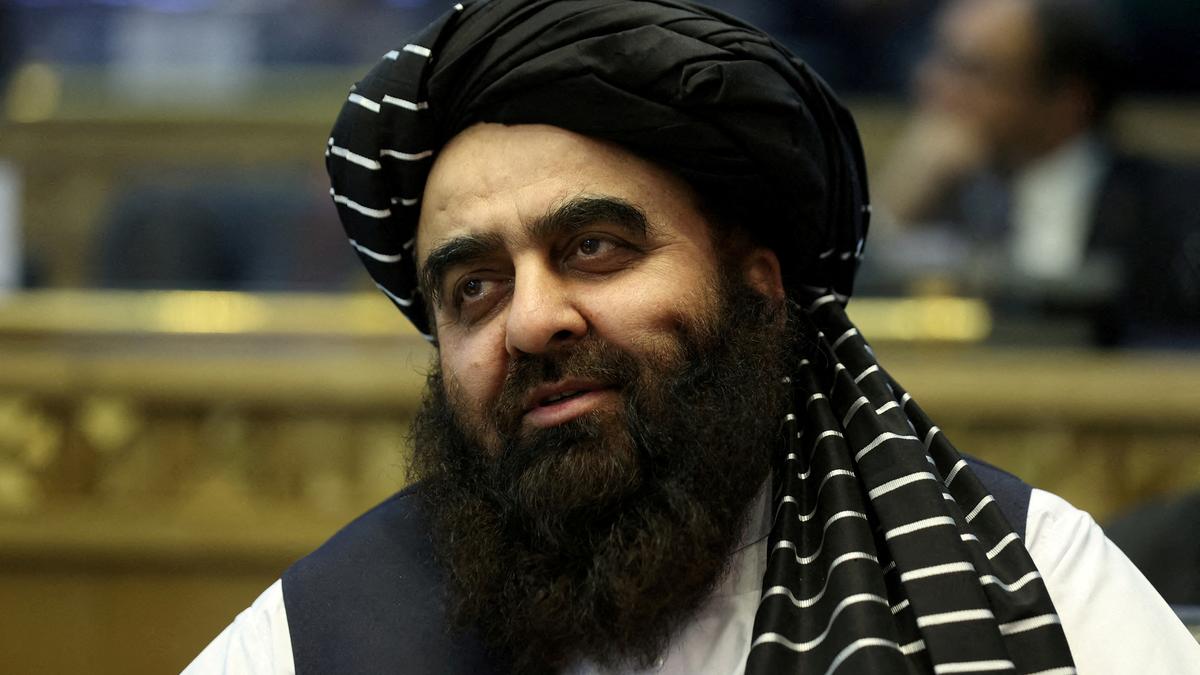
The visit of Foreign Minister Amir Khan Muttaqi to India, the first visit by a top Taliban leader since they returned to power in 2021, comes at a time when India is seeking to regain its strategic space.
After exiting lock, stock and barrel following the fall of Kabul to the Taliban on August 15, 2021, New Delhi moved back to Kabul in June 2022 with a technical mission, with a declared objective of assisting delivery of humanitarian assistance to Afghans. While it also appeared to be a strategic gamble in finding a foothold again in Afghanistan, India’s policy thereafter seems to be following the same trajectory and repeating the follies that was a feature of the two decades of international intervention.
Even three years after that decision, India remains slow and tentative about how to deal with the Taliban regime and even less sure about the ways to help a country in need. Meanwhile, other countries, including those contending for the same strategic space as India, have taken more decisive steps.
More than 17 countries operate their embassies in Kabul. Though Russia is the only country to have recognised the Taliban’s Islamic Emirate, Taliban representatives have been received as Ambassadors in several countries including China. Beijing has an official Ambassador to Afghanistan who operates from the Chinese embassy. Pakistan is seriously considering appointing an Ambassador to Kabul, though its bilateral relations with Afghanistan have not been the best. In contrast, the Indian mission in Kabul houses its technical mission’s skeleton staff with a layered, oversized security presence. The Afghan embassy in New Delhi still flies the flag of the Republic, though it functions as a representative of the de facto authorities.
During the two decades of the Republic in Afghanistan, India’s development-centred partnership with the erstwhile Republican government is a stark reminder of the lacunae that could have been addressed to increase aid effectiveness, build long-term institutions, and translate the soft power approach to tangible gains. The Parliament building, an edifice of democracy, which India helped build, is now shut. The tall mast India erected to fly the flag of the Republic now flies the Taliban flag. The cold storage in Kandahar does not run to optimal utility. The pledge of more than $3 billion had been largely successful in building India’s image and accruing good will, but had concomitantly raised expectations that could not be met.
Assessing India’s aid
Unlike international aid giving, most of Indian projects were based on Afghan needs and priorities which was deemed a useful method of aid delivery. However, they mostly resulted in elite buy-in with little trickle-down effect to the people. In the absence of accountability and measures to gauge aid effectiveness, there was little understanding of working and utility of the projects, particularly in far-flung provinces. The Small Development Projects (SDPs) were more effective than large-scale high-visibility infrastructure projects, which were delayed and incurred massive costs. What was lacking in what appeared to be a sincere Indian contribution to Afghan’s economic development was concerted efforts at institution building and an inbuilt business sustainability plan that could have linked agricultural produce, handicrafts, and artisan work to markets in India. While other countries indulged in a lessons-learnt policy exercise, Indian policy makers do not deem such lessons necessary.
The opening of the technical mission and engagement with the Taliban has one again raised expectation inside Afghanistan. And yet, the mistakes of the past appear to be continuing.
The Afghans are in need of visas for medical, educational and other opportunities. However, India, which shut the visa services for several months, has started providing only a paltry number of online visas. The personnel at the Indian mission hardly venture out of the chancery and thus has little contact with the Afghans, which they repeatedly point out. I travelled to Kabul from Delhi on a Fly Dubai flight via Dubai and returned by a direct Kabul-Delhi flight operated by the Afghan carrier Kam Air. The Fly Dubai flight to Kabul from Dubai was fully occupied. The Kam Air flight, in contrast, was not even one-third full. In the days of the Republic, Kam Air used to operate daily flights between Kabul and Delhi, including weekly flights from Kandahar. Today, Kam Air operates merely two flights every week. India has not opened its arms to the Afghan nationals in medical, educational and business needs, despite its repeated official assertions of standing by the Afghan people. India’s good neighbour image that comes naturally to the minds of an average Afghan has thus been dented.
The Taliban have made numerous outreach attempts to India, while New Delhi has dilly-dallied on the engagement vs recognition debate. Deterioration of Afghanistan-Pakistan ties over the issue of Tehreek-e-Taliban Pakistan and refugees has led to a warming of relations between India and the Taliban. In early January, India’s Foreign Secretary travelled to Kabul to meet Mr. Muttaqi. Less than four months later, the Taliban condemned the Pahalgam terror attack, in an indirect rebuke to Pakistan. In May, India’s External Affairs Minister had a telephone conversation with Mr. Muttaqi, possibly to thank him for the support. India also opened the Wagah border crossing as a goodwill gesture to allow 160 Afghan trucks carrying goods to enter India. Each of these events have raised the possibility of greater cooperation between a regime that is eager for engagement and a government that needs to regain the strategic space which was lost in August 2021. However, there has been very little on progress on the ground.
Break the impasse
This inertia needs to be broken, especially at a time when Indian foreign policy has faced enormous challenges from global and regional events, particularly a troubled neighbourhood. And the specific areas in which India can step in are multiple.
During my visit, I found a yearning among the Afgahns for India to do more. I held discussions with personnel from the National Development Corporation (NDC). Established by the previous government in 2018, the NDC has remained central to the Taliban’s economic planning and proposed march to self-sufficiency through local production of goods. The policy has been to move away from being a rentier state dependent on external aid towards revenue generation and provide employment. These are incremental steps, which with external support can bolster Afghanistan’s bid to regain its independent status, just not by improving security but also its economy and governance systems.
In the Taliban’s 2022-23 budget, the NDC received a $16-million grant, which was upgraded to $23 million in the subsequent year. With that, the NDC is implementing projects relating to canals, mines, dams, industrial parks, and hospitals. Its key plans include upgrading the Kajaki Dam in Helmand Province, the Kamal Khan Dam in Nimruz Province, and several hydroelectric projects around Kabul. India needs to look at the possibility of expanding cooperation in the field of industry, agriculture, health, mining, dams, and irrigation systems by providing technical assistance and institutional support to enhance water management and agricultural productivity and help establish industrial parks and manufacturing hubs to aid in employment opportunities and revenue generation.
As Afghanistan traverses its trajectory of transition, there is a need for dialogue and engagement to address the needs of the people on the ground. Beyond the technical mission, there is a need to restart the SDPs, help MSMEs and local small-scale infrastructure projects. The SDPs in agriculture and alternative livelihood will help rebuild the social and economic capital. Greater exchange and investment by FICCI and the Afghan Chamber of Commerce will be a force multiplier for trade and transit. Investment in hard infrastructure will help revive Afghanistan as a bridge for transit and connectivity.
The Taliban are learning the ropes of foreign policy making, the emphasis being on maintaining balance, increasing regional cooperation and restoring Afghanistan as a land bridge between South and Central Asia. In an interaction, during my visit, Mr. Muttaqi pointed out that the Islamic Emirate’s foreign policy is centred on “balance and economic cooperation”, seeking to open “a new chapter of relations with regional neighbours”. Before arriving in India, Mr. Muttaqi attended a regional meeting in Moscow where India, Pakistan, Iran, China and several Central Asian countries, issued a joint statement which indirectly signalled of opposition to US President Donald Trump’s stated objective to retake control of the Bagram military base near Kabul.
Dr. Shanthie Mariet D’Souza is a Founder of the Mantraya Institute of Strategic Studies (MISS); a Senior Research Fellow, University of Massachusetts-Amherst, U.S.; and Visiting Faculty, Naval War College, Goa. She has worked with governmental and non-governmental sectors and conducted field visits to various provinces in Afghanistan for more than a decade; views expressed are personal
Published – October 10, 2025 12:21 am IST